

The sky was overcast when we headed out of Long Beach and only broke up when we arrived back to the mainland. Mike and I were worried that the predicted large swell would make us sick. Lucky for us, conditions seemed less bad than the week before and the Island Time powered through no problem. On the way through the channel we saw a pod of porpoises and two whales breaching!
Dive No: 30
Location: Catalina
Conditions: 6-8 ft swell
Vis: 25-30
Surface Temp: 66
Temp:
Depth: 60 ft
Gear: My own - 7x7 wetsuit with hood, Tusa X-treme split fins, gloves, booties.
Rented from Sports Chalet in Arcadia - BC, Regulator
Weight: Lead 4x2, 2x2 = 8
Tank: AL 80
Starting PSI: 3000
Ending PSI: 1200
Bottom Time:
Total Bottom Time:
Creatures: Arrow Crab, Lobster, Banded Goby, Black Eyed Goby, Garibaldi, Senorita
Dive Buddy: Mike
Dive Group:
Seems like I'm not overweighted but I never can expell enough air to get down. Mike gave me some weights and then I pulled myself along the anchor line till I got to the bottom and we then headed straight out from the boat. Once we got going I realized my compass and computer were both malfunctioning. The compass had cracks and once we got to depth it promptly got stuck. Good thing, that Mike is great at navigation. The computer suddenly started flashing a low battery notice and zeroed out all my dive info. We continued the dive but I was frustrated since I was hoping to get some time in on my navigation and for once having my own dive info. I suppose we could have aborted but since we were only down really to about 30 feet we decided to continue. Every once in a while, Mike would flash me his instruments. However, 2/3 of the way through the dive I started having a lot of trouble staying down. We both tried to dump my valve but nothing was coming out. I ended the dive hugging kelp at 15 ft while Mike swam around for 15 minutes. We then ascended together.
Dive No: 31
Location: Catalina
Conditions: 6-8 ft swell
Vis: 25-30
Surface Temp: 66
Temp:
Depth: 60 ft
Gear: My own - 7x7 wetsuit with hood, Tusa X-treme split fins, gloves, booties, watch.
Rented from Sports Chalet in Arcadia - BC, Regulator
Weight: Lead 4x2, 3x2 = 14
Tank: AL 80
Starting PSI: 3000
Ending PSI: 600
Bottom Time:
Total Bottom Time:
Creatures: Giant Black Sea Bass, Opaleye
Dive Buddy: Mike
Dive Group:
I swim so slow so I kept trying to get my buddy to chill out on this dive. We almost lost each other at one point, but luckily were able to meet up underwater. We saw a giant black sea bass, but weren't fast enough to keep up with that ghost. I remembered seeing two little points at the far end of the cove and felt the current tugging around in a different direction. I was pretty sure we over shot the boat by quite a lot, so I grabbed his fin and asked him to turn around. As we were signaling each other we floated up to the surface, perfect for taking our bearings and going down again. My weight felt better but I still had some trouble at the last 10 feet or so on ascent with a near empty tank. I have discovered that I don't like aluminum tanks at all.
The Sports Chalet in Arcadia refunded money for the entire scuba rental after I told them about my gauge troubles, so that's a plus for their customer service. Since my buddy had a Hero camera, we were able to watch videos of our entire dives when we got home. He was surprised he touched the bottom with his hand so much and I looked like a total runaway hot air balloon as I was holding onto the kelp for dear life. We did get the tail of the bass though and a shot of the whale breaching! Unfortunately, I am off scuba till my doctor gives me the ok to dive. Hopefully that will be soon.
Dive No: 30
Location: Catalina
Conditions: 6-8 ft swell
Vis: 25-30
Surface Temp: 66
Temp:
Depth: 60 ft
Gear: My own - 7x7 wetsuit with hood, Tusa X-treme split fins, gloves, booties.
Rented from Sports Chalet in Arcadia - BC, Regulator
Weight: Lead 4x2, 2x2 = 8
Tank: AL 80
Starting PSI: 3000
Ending PSI: 1200
Bottom Time:
Total Bottom Time:
Creatures: Arrow Crab, Lobster, Banded Goby, Black Eyed Goby, Garibaldi, Senorita
Dive Buddy: Mike
Dive Group:
Seems like I'm not overweighted but I never can expell enough air to get down. Mike gave me some weights and then I pulled myself along the anchor line till I got to the bottom and we then headed straight out from the boat. Once we got going I realized my compass and computer were both malfunctioning. The compass had cracks and once we got to depth it promptly got stuck. Good thing, that Mike is great at navigation. The computer suddenly started flashing a low battery notice and zeroed out all my dive info. We continued the dive but I was frustrated since I was hoping to get some time in on my navigation and for once having my own dive info. I suppose we could have aborted but since we were only down really to about 30 feet we decided to continue. Every once in a while, Mike would flash me his instruments. However, 2/3 of the way through the dive I started having a lot of trouble staying down. We both tried to dump my valve but nothing was coming out. I ended the dive hugging kelp at 15 ft while Mike swam around for 15 minutes. We then ascended together.
Dive No: 31
Location: Catalina
Conditions: 6-8 ft swell
Vis: 25-30
Surface Temp: 66
Temp:
Depth: 60 ft
Gear: My own - 7x7 wetsuit with hood, Tusa X-treme split fins, gloves, booties, watch.
Rented from Sports Chalet in Arcadia - BC, Regulator
Weight: Lead 4x2, 3x2 = 14
Tank: AL 80
Starting PSI: 3000
Ending PSI: 600
Bottom Time:
Total Bottom Time:
Creatures: Giant Black Sea Bass, Opaleye
Dive Buddy: Mike
Dive Group:
I swim so slow so I kept trying to get my buddy to chill out on this dive. We almost lost each other at one point, but luckily were able to meet up underwater. We saw a giant black sea bass, but weren't fast enough to keep up with that ghost. I remembered seeing two little points at the far end of the cove and felt the current tugging around in a different direction. I was pretty sure we over shot the boat by quite a lot, so I grabbed his fin and asked him to turn around. As we were signaling each other we floated up to the surface, perfect for taking our bearings and going down again. My weight felt better but I still had some trouble at the last 10 feet or so on ascent with a near empty tank. I have discovered that I don't like aluminum tanks at all.
The Sports Chalet in Arcadia refunded money for the entire scuba rental after I told them about my gauge troubles, so that's a plus for their customer service. Since my buddy had a Hero camera, we were able to watch videos of our entire dives when we got home. He was surprised he touched the bottom with his hand so much and I looked like a total runaway hot air balloon as I was holding onto the kelp for dear life. We did get the tail of the bass though and a shot of the whale breaching! Unfortunately, I am off scuba till my doctor gives me the ok to dive. Hopefully that will be soon.

Darn that channel ride. There were 6-8 ft swells on the way over so I got kind of sick on the way to Catalina and ended up skipping my first dive. My buddy was sick too so she ended up skipping the first two. Getting re-buddied up and sorting out weighting was confusing, but underwater conditions were nice and calm near the island. Jenna Nichols was on the boat with Reef Check surveys and ID photos of various fish and plants. I went over them quickly and the info made the dives much more fun.
Dive No: 28
Location: Catalina
Conditions: 6-8 ft swell
Vis: 25-30
Surface Temp: 68
Temp:
Depth: 60 ft
Gear: My own - 7x7 wetsuit with hood, Tusa X-treme split fins, gloves, booties, watch.
Rented from Sports Chalet in Arcadia - BC, Regulator
Weight: Lead 3x3, tank strap 2 = 8
Tank: LP 80
Starting PSI: 3000
Ending PSI:
Bottom Time:
Total Bottom Time:
Creatures:
Dive Buddy: Sasha and Matt, Brona and Yvette, Robert and ???
Dive Group:
Sasha an I both had a hard time getting down with only 6 lbs of weight so the group Matt, Brona, ??? went off first and Sasha and I followed. Sasha apparently went down line, lost them, and went back to the boat, but I didn't know that. I swam out to the bubbles and dropped in. I saw four people when I got to the bottom and started following what I thought was Matt and Sasha. I kicked around with them for awhile and surfaced with them, and figured out it was Robert and his buddy, ???. I guess I should have known since Matt and Sasha were diving their own tanks which were white. However, I did come back with my slate marked with some fish.
Dive No: 29
Location: Catalina
Conditions:
Vis: 15-25
Surface Temp: 68F
Temp:
Depth: 50
Gear: My own - 7x7 wetsuit with hood, Tusa X-treme split fins, gloves, booties, watch.
Borrowed -
Tank: HP 80
Starting PSI: 3000
Ending PSI:
Bottom Time:
Total Bottom Time:
Creatures: Giant Kelpfish,
Dive Buddy: Christina
Dive Group: Matt, Sasha, Brona
On the second dive, Christina felt better after a nap and decided to join. She was a bit overweighted, was struggling with her buoyancy and had a runaway ascent towards the end but none the worse for wear. I tried to watch over her and gave her a hand a few times to keep her from floating off. When she signaled to me that she hit the halfway mark on her air, I gave her the ok and stay, and went to notify our buddies that we were were going up. However, when I turned around she had disappeared. I hovered for awhile, ascending a little bit at a time and finally surfaced. After I showed the boat my OK sign I asked them where Christina was. Thankfully, she was already aboard. She told me later that she tried to get back down but was having trouble. The situation was just like what had happened to me. Frightening how quickly something like that occurs and how important it is to stay together especially in low vis or dense kelp.
Both dives had a lot of sealife right near the boat and I loved how Sasha and Matt dove really, really slow, often hovering for long periods around a rock or some interesting group of animals. The Reef check helped me identify lots of things that I would otherwise have missed. I think a nice book with photos is something I definitely want for the future. A book is also a great thing to have while on a trip.
Crew on the boat were attentive and understanding. The DM helped me to set up my gear since I was feeling sick. Since my friend was so sick, they gave her half off of her trip price.
Cost of reg set/cost of yearly maintenance = real cost
REG 1 (online)
350 for stages
60 hoses
60 labor
60 parts kit
20 shipping
410/140=2.9
REG 2 (from a lds)
625 for stages and hoses
50 taxes
60 labor with discount, first year free
0 parts
0 shipping
675/60=11.25
REG 2 (from grey market)
525 for stages and hoses
50 labor
60 parts
20 shipping
525/130=4.0
or
525 for stages and hoses
75 for labor
60 parts
0 shipping
525/135=3.9
REG 1 (online)
350 for stages
60 hoses
60 labor
60 parts kit
20 shipping
410/140=2.9
REG 2 (from a lds)
625 for stages and hoses
50 taxes
60 labor with discount, first year free
0 parts
0 shipping
675/60=11.25
REG 2 (from grey market)
525 for stages and hoses
50 labor
60 parts
20 shipping
525/130=4.0
or
525 for stages and hoses
75 for labor
60 parts
0 shipping
525/135=3.9
Today was the last minute Meet and Greet for Scubaboard which was really fun. I had a good time watching people set up and break down their gear and shoot the shit. The weather was beautiful and conditions over all were fair - meaning, what a beautiful day!
Dive Summary:
Date: Sunday June 12, 2010
Dive No: 26
Location: Monterey, Breakwater, The Barge
Conditions: Slight swell
Vis: 10-15
Temp:
Depth: 60 ft
Gear: My own - 7x7 wetsuit with hood, Tusa X-treme split fins, gloves, booties, watch.
Borrowed - Deep Sea Supply Singles Rig, Long Hose, Scubapro Regs, Uwatec Bottom Timer
Weight: BP 5, Cam Bands 1x2, Lead 3x3, Lead 2x2 = 17
Tank: HP 80
Starting PSI: 3600
Ending PSI: 100
Time in:
Time down:
Time up:
Time out:
Bottom Time:
Total Bottom Time:
Creatures: various fish, small lone jellyfish with a blue rim, lemon nudibranchs, crabs, sea lions in on the surface large and bull sea lion.
Dive Buddy: Don
Dive Group: Doug and Kristina
We followed the pier out to where the walkway ended and dropped down to sandy bottom at 60 ft, covered with little eels/worms and tiny flounder. We followed a line all the way to a floaty water bottle and then south a bit. I guess we got lost so we turned around and started from the floaty bottle straight out from the line and hit the end of the barge. Really, it was just a pile of long thick planks of wood all covered in starfish. I was having a good time peeping at the fish under the ledge and the humongous crab all camouflaged and craggy. Towards the end of the dive I had some difficulty venting my wing. I later discovered that since I was doing pretty good with trim, I wasn't actually lifting my shoulders enough to vent properly. I was also pulling the string on the dump valve towards the front (I think, anyway. My fingers were a bit numb at that point.) instead of towards the back and side.
After about 1500 psi we turned around the way we came, making our way up to the wall of the Breakwater and dove along it. Apparently, I swam off after hitting 700 psi, because I didn't read Don's hand signals well enough to stop at first. When I figured out what he was trying to tell me, we did safety stops at 30, while attempting to hover. I guess I was sinking down so Don flashed me his depth gauge and pointed at a strand of kelp so I could get my bearings. After that it was easier to watch how I was drifting. We did another stop at 20, then we tried doing a last stop at 10. When I looked at my pressure gauge, I realized I was really low on air and pointed at my SPG to my buddy. Immediately he twisted his hose around in an S and handed it to me. I took a breath from my own reg and then started breathing from his. Together we ascended to surface slowly. Kristina told us later that she joined in as third person buddy once she knew what was happening. I was so gratified that everyone in our group was so great at staying together although we did jostle each other some times or start floating on top of each other. Don was really good guiding me through each difficulty the whole time, and he probably deserves some payment for all the gear he lent me and the instruction he gave.
Dive No: 27
Location: Monterey, Breakwater, Metridium Fields
Conditions: Slight swell
Vis: 10-15
Temp: 49F
Depth: 45 ft
Gear: My own - 7x7 wetsuit with hood, Tusa X-treme split fins, gloves, booties, watch.
Borrowed - Deep Sea Supply Singles Rig, Long Hose, Scubapro Regs, Uwatec Bottom Timer
Weight: BP 5, Cam Bands 1x2, Lead 3x3 = 13
Tank: HP 80
Starting PSI: 3600
Ending PSI: 1600
Bottom Time:
Total Bottom Time:
Creatures: fried egg jelly (It's big and beautiful!), that crazy many legged starfish, metridium (giant cauliflower fields of snow), a tiny purple and gold shelled fluorescent orange snail chilling on a leaf (Calliostoma Annulatum), tiny baby fish swimming at the base of the kelp forest for cover, a burgundy fish with markings that allowed it to camouflage into the kelp "bushes".
Dive Buddy: Don
Dive Group: Doug and Kristina, Ben and Ted
Second dive was much more controlled. My weight felt right and I was able to use my inflator more efficiently and stay in trim better, concentrate on conserving more air through breath control and generally feeling more relaxed. Don told me that if I feel like I need to scull or am lifting up, then tap the appropriate BC button. That seemed to really help. We started at about 30 odd feet and went down to about 50 ft. Then we turned around following the big pipe, and I felt mostly stable and able to regulate my buoyancy. Don told me to try inflating and dumping the wing as I traveled, but I never did get around to it. Maybe a skill I will try next time. At the end of the pipe, we turned inland and towards the breakwater. However, we ended the dive doing SMB drills at about 11 feet of water nearer to the shore. This was tough, trying to stay motionless as the surf washed over us and the neutral buoyancy went out the window. As I started working hard to swim, I started breathing harder and floating up more and more. I had to really tell myself to calm down so I would stay down. Meanwhile, I was also trying to stay de-tangled from everyone's deployed line. I guess I also still had some air in my wing to let out but went up without relative mishap. I thiink I forgot to help my buddy hold his SMB to reroll, but I did retrieve his double bolt snap from the bottom while trying to stay neutral during the skills practice. We were trying to angle back towards the wall but we didn't quite make it and surfaced in the middle of some kelp. I did the kelp crawl which I actually think is fun and we were almost out of the tangleweeds when Kristina found a strand of dangling line. It belonged to Doug's SMB and apparently, the reel had gotten unclipped and fell to the seabed like an anchor. No problem! Don went freediving and Kristina helped to reel it in. Got to shore without further complications. In fact, surface swimming the second dive seemed easier to me and everyone seemed in good spirits at the end. Yay!
Summary:
Pre Dive - Need to review bookwork and videos. Need own gear already. Need some kind of depth gauge. Make personal checklist of stuff to bring (doh! forgot towel and rubberband for hair). Tarp.
Dive Stuff - Also, I think I need to review dive plans before the dive rather than while swimming, because I think I'm concentrating too much on kicking and not really listening to all the convos around. Soak the straps before donning.
Post Dive - Shower your gear before showering yourself. Log that stuff immediately. Pick a skill to practice every dive day, and then do it. Ben's ingenious quick post dive washing solution - various size milk crates that go direct into a soaking water tub once you get home. After the rinse, leave it out to drain. Nice!
I really liked diving the long hose, BP/W setup in the ocean. The backplate was the smallest I've tried yet, and was really a great fit with the smaller tank. It was a little less stable side to side, but in a way, the rig just seemed more responsive. I loved not having to swim around in an air donut around my chest. The way the hoses were snapped and routed were clean and easy to reach. Getting used to the order of donning/doffing is still not totally automatic for me, but not a transition that should be too difficult. It was also easy to figure out where everyone else's important gear was stashed on their body. A definite plus!
Dive Summary:
Date: Sunday June 12, 2010
Dive No: 26
Location: Monterey, Breakwater, The Barge
Conditions: Slight swell
Vis: 10-15
Temp:
Depth: 60 ft
Gear: My own - 7x7 wetsuit with hood, Tusa X-treme split fins, gloves, booties, watch.
Borrowed - Deep Sea Supply Singles Rig, Long Hose, Scubapro Regs, Uwatec Bottom Timer
Weight: BP 5, Cam Bands 1x2, Lead 3x3, Lead 2x2 = 17
Tank: HP 80
Starting PSI: 3600
Ending PSI: 100
Time in:
Time down:
Time up:
Time out:
Bottom Time:
Total Bottom Time:
Creatures: various fish, small lone jellyfish with a blue rim, lemon nudibranchs, crabs, sea lions in on the surface large and bull sea lion.
Dive Buddy: Don
Dive Group: Doug and Kristina
We followed the pier out to where the walkway ended and dropped down to sandy bottom at 60 ft, covered with little eels/worms and tiny flounder. We followed a line all the way to a floaty water bottle and then south a bit. I guess we got lost so we turned around and started from the floaty bottle straight out from the line and hit the end of the barge. Really, it was just a pile of long thick planks of wood all covered in starfish. I was having a good time peeping at the fish under the ledge and the humongous crab all camouflaged and craggy. Towards the end of the dive I had some difficulty venting my wing. I later discovered that since I was doing pretty good with trim, I wasn't actually lifting my shoulders enough to vent properly. I was also pulling the string on the dump valve towards the front (I think, anyway. My fingers were a bit numb at that point.) instead of towards the back and side.
After about 1500 psi we turned around the way we came, making our way up to the wall of the Breakwater and dove along it. Apparently, I swam off after hitting 700 psi, because I didn't read Don's hand signals well enough to stop at first. When I figured out what he was trying to tell me, we did safety stops at 30, while attempting to hover. I guess I was sinking down so Don flashed me his depth gauge and pointed at a strand of kelp so I could get my bearings. After that it was easier to watch how I was drifting. We did another stop at 20, then we tried doing a last stop at 10. When I looked at my pressure gauge, I realized I was really low on air and pointed at my SPG to my buddy. Immediately he twisted his hose around in an S and handed it to me. I took a breath from my own reg and then started breathing from his. Together we ascended to surface slowly. Kristina told us later that she joined in as third person buddy once she knew what was happening. I was so gratified that everyone in our group was so great at staying together although we did jostle each other some times or start floating on top of each other. Don was really good guiding me through each difficulty the whole time, and he probably deserves some payment for all the gear he lent me and the instruction he gave.
Dive No: 27
Location: Monterey, Breakwater, Metridium Fields
Conditions: Slight swell
Vis: 10-15
Temp: 49F
Depth: 45 ft
Gear: My own - 7x7 wetsuit with hood, Tusa X-treme split fins, gloves, booties, watch.
Borrowed - Deep Sea Supply Singles Rig, Long Hose, Scubapro Regs, Uwatec Bottom Timer
Weight: BP 5, Cam Bands 1x2, Lead 3x3 = 13
Tank: HP 80
Starting PSI: 3600
Ending PSI: 1600
Bottom Time:
Total Bottom Time:
Creatures: fried egg jelly (It's big and beautiful!), that crazy many legged starfish, metridium (giant cauliflower fields of snow), a tiny purple and gold shelled fluorescent orange snail chilling on a leaf (Calliostoma Annulatum), tiny baby fish swimming at the base of the kelp forest for cover, a burgundy fish with markings that allowed it to camouflage into the kelp "bushes".
Dive Buddy: Don
Dive Group: Doug and Kristina, Ben and Ted
Second dive was much more controlled. My weight felt right and I was able to use my inflator more efficiently and stay in trim better, concentrate on conserving more air through breath control and generally feeling more relaxed. Don told me that if I feel like I need to scull or am lifting up, then tap the appropriate BC button. That seemed to really help. We started at about 30 odd feet and went down to about 50 ft. Then we turned around following the big pipe, and I felt mostly stable and able to regulate my buoyancy. Don told me to try inflating and dumping the wing as I traveled, but I never did get around to it. Maybe a skill I will try next time. At the end of the pipe, we turned inland and towards the breakwater. However, we ended the dive doing SMB drills at about 11 feet of water nearer to the shore. This was tough, trying to stay motionless as the surf washed over us and the neutral buoyancy went out the window. As I started working hard to swim, I started breathing harder and floating up more and more. I had to really tell myself to calm down so I would stay down. Meanwhile, I was also trying to stay de-tangled from everyone's deployed line. I guess I also still had some air in my wing to let out but went up without relative mishap. I thiink I forgot to help my buddy hold his SMB to reroll, but I did retrieve his double bolt snap from the bottom while trying to stay neutral during the skills practice. We were trying to angle back towards the wall but we didn't quite make it and surfaced in the middle of some kelp. I did the kelp crawl which I actually think is fun and we were almost out of the tangleweeds when Kristina found a strand of dangling line. It belonged to Doug's SMB and apparently, the reel had gotten unclipped and fell to the seabed like an anchor. No problem! Don went freediving and Kristina helped to reel it in. Got to shore without further complications. In fact, surface swimming the second dive seemed easier to me and everyone seemed in good spirits at the end. Yay!
Summary:
Pre Dive - Need to review bookwork and videos. Need own gear already. Need some kind of depth gauge. Make personal checklist of stuff to bring (doh! forgot towel and rubberband for hair). Tarp.
Dive Stuff - Also, I think I need to review dive plans before the dive rather than while swimming, because I think I'm concentrating too much on kicking and not really listening to all the convos around. Soak the straps before donning.
Post Dive - Shower your gear before showering yourself. Log that stuff immediately. Pick a skill to practice every dive day, and then do it. Ben's ingenious quick post dive washing solution - various size milk crates that go direct into a soaking water tub once you get home. After the rinse, leave it out to drain. Nice!
I really liked diving the long hose, BP/W setup in the ocean. The backplate was the smallest I've tried yet, and was really a great fit with the smaller tank. It was a little less stable side to side, but in a way, the rig just seemed more responsive. I loved not having to swim around in an air donut around my chest. The way the hoses were snapped and routed were clean and easy to reach. Getting used to the order of donning/doffing is still not totally automatic for me, but not a transition that should be too difficult. It was also easy to figure out where everyone else's important gear was stashed on their body. A definite plus!
I've been frustrated with my drysuit search and thus quiet on any scuba progress. This weekend however, I did go to Point Lobos. What a beautiful spot on land and in the water. However, the surface swim was killer. I seem to move much slower than everyone else, because I have broken fins (splits) and also because I'm sort of flail kicking as propulsion. Not very pretty. After the initial "normal" difficulty dropping, I descended a bit faster than I like - I'm a slow equalizer - and ended up accidentally kicking my way to the surface surprisingly quick. When I calmed down a bit, I again dropped down quickly, kicking slightly up to slow myself. However, just before I hit the cold water column I was dropping like a stone till I hit the sandy bottom. I apparently missed the memo where we were going to slide to a stop at 30 ft.
Confused, I tried to put some air into my wings, but nothing happened. I tried again, but I couldn't feel the lift. Then I just bashed the inflator button and looked skyward. Still nothing. Since, my buddy was beckoning to me, I pushed myself off the bottom and started swimming. My buddy, he had a goal, which was the beginning of the wall, and he just made for it. I had a hard time keeping up with him. At one point, I saw a couple nudibranchs and slowed to look at them beckoning my buddy to come over. But, well ahead of me, my buddy was signaling to for me to pass through a little crevice and took off so I felt like I had to follow. At that point the other two guys in our group dropped away. My buddy signaled not to worry about them. Turns out they were fine, since one was photographing. But it felt strange since they waited for us all morning so we could dive together despite my buddy telling them to go off on their own.
Finally, I think I was over weighted. When I got in the water, he said he thought my neutral buoyancy was good but I thought that was weird considering I had my BCD fully inflated and I hadn't yet let out a deep breath. I was also carrying a steel tank (LP 65 - my buddy insisted I should rent a small tank) rather than the usual AL 80, and a Zeagle BCD with back inflate and lots of fluffy back padding and random doodads but no snap to hang the console from! Swimming was just a drag underwater and on the surface as well - nothing like swimming in big Los Angeles surf but less surge than when I was in Catalina at least. I didn't stuff my weights myself, which in retrospect is like a trusting someone else to pack your parachute for you and then jumping off a cliff when you have no idea how high it is. But I know I had at least 18 lbs of lead total - two large very heavy soft weights in the pockets and 4 smaller bullets on a belt (need to check the shop for size comparison).
I was also using a computer, never having had one myself, and also thinking erroneously this one would be straight forward. I didn't have a separate depth gauge, which was disconcerting. I was also trying to figure out my compass but never got that sorted out either. I feel like my lessons up to now have been useless, not like bad instruction useless, but bad mostly because I never got to practice and drill that stuff into my head. At 1000 psi, I tried to grab my buddy to let him know that I needed to turn back and had to sprint to catch him. The trip back to the ascent point seemed much shorter than the way out.
My buddy had his eyes on his compass so he didn't notice when I made a quick exit involuntarily to the surface. What happened? As I was struggling to keep up, I thought that he was diving back deeper because the light was starting to dim and he seemed to be getting further below me. I tried to duck dive down to him but couldn't get far enough to reach him. When I stopped swimming to get my bearings, I found myself "bloop" rising quickly and then surrounded by bubbles. At the surface, I tried looking down into the water to see if he was there. And then all around to see if he had surfaced. I waited for a minute or two. Then the thought slowly crossed my mind that I would have no idea what to do if he never surfaced. Since no one else was out on the water and I was tired, I started swimming towards the shore. After doing a pit stop on my back I rolled over and saw his head pop up.
He told me later that he saw me after I surfaced and was doing his safety stop. Later on, he made it clear that he would have waited for me if I had surfaced first. In terms of buddy etiquette, I can agree about my mistake. He also said I was using my hands a lot, which was true (probably the first dive where I actually thought to myself hey, put your hands on your belt, but then I felt uncomfortable keeping them there) because I was really working hard underwater. When he got back he asked how much air I had left, and then told me he still had 1800 psi in his miniature high pressure steel tank and how the wall drop off where we stopped was where he usually starts his dives. It was sobering until I realized later that we could have shortened the surface swim back to shore with the air we had left.
This comedy of errors, as my buddy would say, made me realize, I really, really need my own gear. Seriously. I have never felt so stressed out or had so much trouble with my buoyancy before. I have never been unable to hold my safety stop. Nor, have I ever felt so rushed or had less leisure time to calm my breathing or look at the fish or study my buddy's technique. Usually, I'm in a mellow peacefully exhilarated state by the end of the dive, but definitely not this time.
I think I feel more comfortable with a more attentive and anal retentive buddy. One who does things by the book or goes into more detail. However, I don't blame this weekend's buddy at all because I was the one who made the final call to continue with the dive after trepidation about my abilities, the long swim, the weights... And I who trusted that my new buddy would steer me right despite my lack of knowledge. I didn't ask when I should have. Well, now I've learned my lesson again. And I hope to retain that knowledge this time. My consolation is that conditions at Lobos weren't absolutely spectacular on Sunday, Oh, And I saw my first Lemon Nudibranch. I love me the nudibranchs.
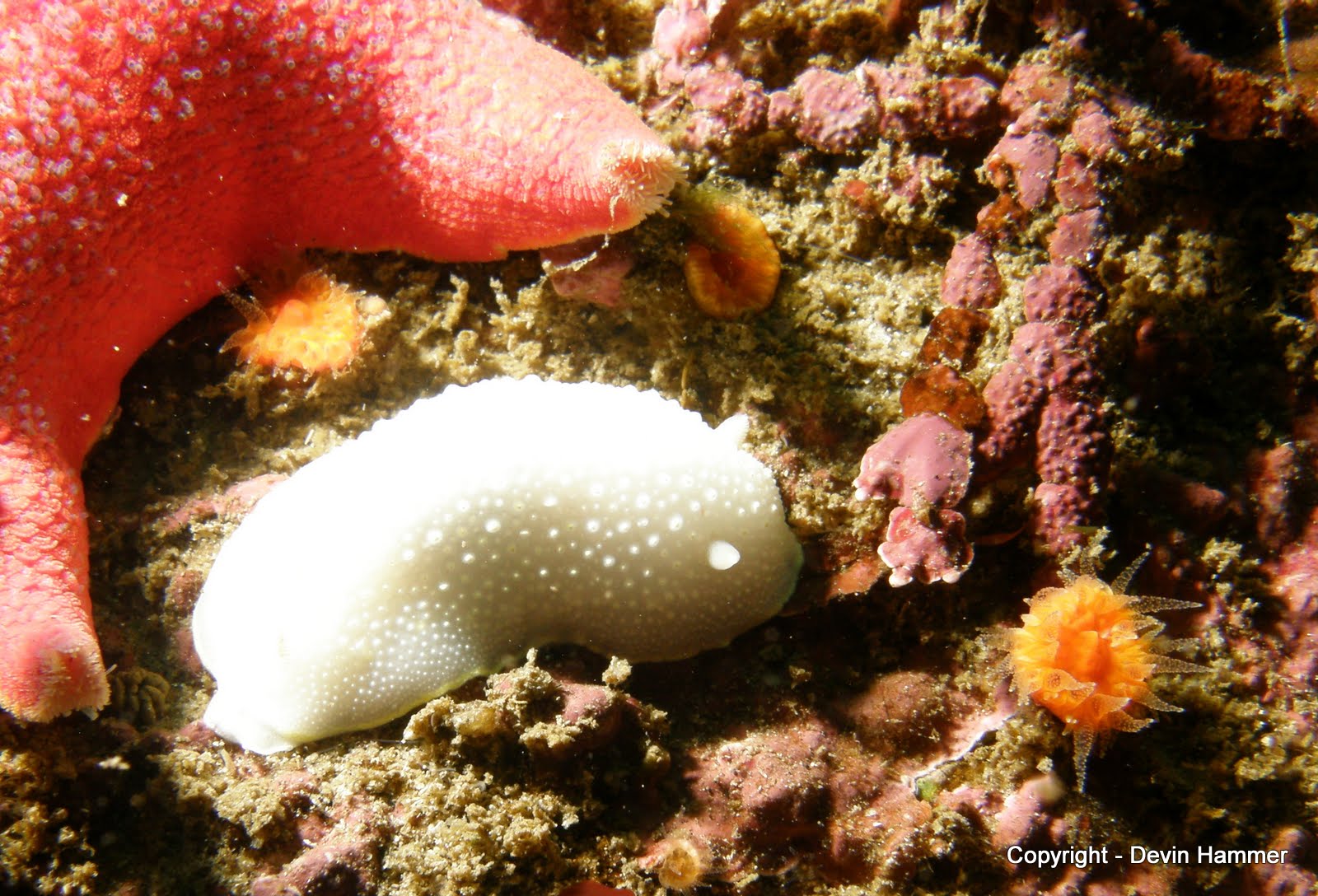
 It really is yellow. This picture was taken by dive buddy Devin Hammer.
Things I now know that 1) I didn't know before or 2) didn't understand why I needed to know them.
1) Find the appropriate tank for your both you and your buddy's gas consumption. When I dive with my friend Mike, I consistently have half a tank still available to me. Under such conditions, I would expect a smaller tank to be sufficient. And for which weights need be adjusted.
2) Now I know why I want a flashlight. Multiple times with this question, "Does GUE require a light for training." Answer. No. Me, in my head, "Hurrah! Now I don't have to buy a $1500 light!" Cautious Pause. But, says GUE diver... We use them to see in bad vis. We use them to see at depth. We use them to get our buddy's attention. We use them to signal if they are further from us. Geebus, I'm such a newb... Thanks GUE divers for being patient. I'm so set on doing this Intro to Tech thing that it's not even funny.
3) If you buy a wetsuit. Buy one with a zipper in the back or front! Not one with an internal 7mm layer attached to the legs that only has a neck/collar opening and has shitty stretch capabilities. Buy a john/jane with a zipper. Buy a two piece with a vest underneath. Whatever. Just get a zipper.
I hate my wetsuit.
4) Check your neutral buoyancy at the beginning of every dive. Check your gauges. Familiarize with equipment. I thought I did, but then I realized I didn't do enough.
5) Always have a Backup dive plan. A GUE/UTI or other denomination, well trained, and familiarized buddy is the way to go. Best to start in a pool, do a shallow dive at a well known easy dive site, then move on to the open water/more challenging stuff. I originally planned to hit Lobos with this under my belt but things got pushed back until suddenly it was Lobos day. Silly thinking.
6) Get the gear already! Geez. Get a setup with a proper brass SPG. Get the correct snaps to put your trailing junk on.
7) Remember how to use the BC to control buoyancy. Without watching a depth gauge diligently, I really didn't know how I was diving except that I was moving up. As a just certed somebody, perhaps following the leader this way is maybe understandable if not completely kosher. But now, I'm not comfortable with this state of affairs at all. Also, unsure about the gas in the wing, I wasn't venting properly. Just an accident waiting to happen.
The more I read and know, the more I find don't know, and thus the more anxiety inducing this stuff is. I've also gotten a little worse since my certification classes were ages ago and I've never practiced. Practice being everything.
Dive Summary:
Date: Sunday June 6, 2010
Dive No: 25
Total Dives:
Total Bottom Time:
Location: Carmel, Point Lobos, Cannery Point
Conditions: Slight swell
Vis: 10-25 variable
Temp: Cold but not unbearable
Depth: 58 feet with a gradually ascending profile
Bottom Time: 24 min
Gear: My own - 7x7 wetsuit with hood, Tusa x-treme split fins, gloves, booties
Borrowed - Zeagle backinflate BCD, regs-small but really noisy
Tank LP 65
Starting PSI: 2500
Ending PSI: 750
Notes : Long Surface swim - at least 1 hour total
Confused, I tried to put some air into my wings, but nothing happened. I tried again, but I couldn't feel the lift. Then I just bashed the inflator button and looked skyward. Still nothing. Since, my buddy was beckoning to me, I pushed myself off the bottom and started swimming. My buddy, he had a goal, which was the beginning of the wall, and he just made for it. I had a hard time keeping up with him. At one point, I saw a couple nudibranchs and slowed to look at them beckoning my buddy to come over. But, well ahead of me, my buddy was signaling to for me to pass through a little crevice and took off so I felt like I had to follow. At that point the other two guys in our group dropped away. My buddy signaled not to worry about them. Turns out they were fine, since one was photographing. But it felt strange since they waited for us all morning so we could dive together despite my buddy telling them to go off on their own.
Finally, I think I was over weighted. When I got in the water, he said he thought my neutral buoyancy was good but I thought that was weird considering I had my BCD fully inflated and I hadn't yet let out a deep breath. I was also carrying a steel tank (LP 65 - my buddy insisted I should rent a small tank) rather than the usual AL 80, and a Zeagle BCD with back inflate and lots of fluffy back padding and random doodads but no snap to hang the console from! Swimming was just a drag underwater and on the surface as well - nothing like swimming in big Los Angeles surf but less surge than when I was in Catalina at least. I didn't stuff my weights myself, which in retrospect is like a trusting someone else to pack your parachute for you and then jumping off a cliff when you have no idea how high it is. But I know I had at least 18 lbs of lead total - two large very heavy soft weights in the pockets and 4 smaller bullets on a belt (need to check the shop for size comparison).
I was also using a computer, never having had one myself, and also thinking erroneously this one would be straight forward. I didn't have a separate depth gauge, which was disconcerting. I was also trying to figure out my compass but never got that sorted out either. I feel like my lessons up to now have been useless, not like bad instruction useless, but bad mostly because I never got to practice and drill that stuff into my head. At 1000 psi, I tried to grab my buddy to let him know that I needed to turn back and had to sprint to catch him. The trip back to the ascent point seemed much shorter than the way out.
My buddy had his eyes on his compass so he didn't notice when I made a quick exit involuntarily to the surface. What happened? As I was struggling to keep up, I thought that he was diving back deeper because the light was starting to dim and he seemed to be getting further below me. I tried to duck dive down to him but couldn't get far enough to reach him. When I stopped swimming to get my bearings, I found myself "bloop" rising quickly and then surrounded by bubbles. At the surface, I tried looking down into the water to see if he was there. And then all around to see if he had surfaced. I waited for a minute or two. Then the thought slowly crossed my mind that I would have no idea what to do if he never surfaced. Since no one else was out on the water and I was tired, I started swimming towards the shore. After doing a pit stop on my back I rolled over and saw his head pop up.
He told me later that he saw me after I surfaced and was doing his safety stop. Later on, he made it clear that he would have waited for me if I had surfaced first. In terms of buddy etiquette, I can agree about my mistake. He also said I was using my hands a lot, which was true (probably the first dive where I actually thought to myself hey, put your hands on your belt, but then I felt uncomfortable keeping them there) because I was really working hard underwater. When he got back he asked how much air I had left, and then told me he still had 1800 psi in his miniature high pressure steel tank and how the wall drop off where we stopped was where he usually starts his dives. It was sobering until I realized later that we could have shortened the surface swim back to shore with the air we had left.
This comedy of errors, as my buddy would say, made me realize, I really, really need my own gear. Seriously. I have never felt so stressed out or had so much trouble with my buoyancy before. I have never been unable to hold my safety stop. Nor, have I ever felt so rushed or had less leisure time to calm my breathing or look at the fish or study my buddy's technique. Usually, I'm in a mellow peacefully exhilarated state by the end of the dive, but definitely not this time.
I think I feel more comfortable with a more attentive and anal retentive buddy. One who does things by the book or goes into more detail. However, I don't blame this weekend's buddy at all because I was the one who made the final call to continue with the dive after trepidation about my abilities, the long swim, the weights... And I who trusted that my new buddy would steer me right despite my lack of knowledge. I didn't ask when I should have. Well, now I've learned my lesson again. And I hope to retain that knowledge this time. My consolation is that conditions at Lobos weren't absolutely spectacular on Sunday, Oh, And I saw my first Lemon Nudibranch. I love me the nudibranchs.
Things I now know that 1) I didn't know before or 2) didn't understand why I needed to know them.
1) Find the appropriate tank for your both you and your buddy's gas consumption. When I dive with my friend Mike, I consistently have half a tank still available to me. Under such conditions, I would expect a smaller tank to be sufficient. And for which weights need be adjusted.
| Height | Tanks |
| 17 Inches | HP65 ~ 3500 psi |
| 20-21 Inches | AL63, LP66 - 2500 psi, HP80 ~ 3600 psi, 30.9 lbs dry, buoyancy -10/-5 lbs |
| 24 Inches | LP80, LP95, HP100, HP119 |
| 26 Inches | AL80, AL100, LP85, LP104 |
| 28-30 Inches | LP120, HP120, HP130 |
| Diameter | Tanks |
| 7-¼ Inches | AL63, AL80, LP80, LP85, HP80, HP100, HP120 |
| 8 Inches | LP95, AL100, LP104, HP119, LP120, HP130 |
2) Now I know why I want a flashlight. Multiple times with this question, "Does GUE require a light for training." Answer. No. Me, in my head, "Hurrah! Now I don't have to buy a $1500 light!" Cautious Pause. But, says GUE diver... We use them to see in bad vis. We use them to see at depth. We use them to get our buddy's attention. We use them to signal if they are further from us. Geebus, I'm such a newb... Thanks GUE divers for being patient. I'm so set on doing this Intro to Tech thing that it's not even funny.
3) If you buy a wetsuit. Buy one with a zipper in the back or front! Not one with an internal 7mm layer attached to the legs that only has a neck/collar opening and has shitty stretch capabilities. Buy a john/jane with a zipper. Buy a two piece with a vest underneath. Whatever. Just get a zipper.
I hate my wetsuit.
4) Check your neutral buoyancy at the beginning of every dive. Check your gauges. Familiarize with equipment. I thought I did, but then I realized I didn't do enough.
5) Always have a Backup dive plan. A GUE/UTI or other denomination, well trained, and familiarized buddy is the way to go. Best to start in a pool, do a shallow dive at a well known easy dive site, then move on to the open water/more challenging stuff. I originally planned to hit Lobos with this under my belt but things got pushed back until suddenly it was Lobos day. Silly thinking.
6) Get the gear already! Geez. Get a setup with a proper brass SPG. Get the correct snaps to put your trailing junk on.
7) Remember how to use the BC to control buoyancy. Without watching a depth gauge diligently, I really didn't know how I was diving except that I was moving up. As a just certed somebody, perhaps following the leader this way is maybe understandable if not completely kosher. But now, I'm not comfortable with this state of affairs at all. Also, unsure about the gas in the wing, I wasn't venting properly. Just an accident waiting to happen.
The more I read and know, the more I find don't know, and thus the more anxiety inducing this stuff is. I've also gotten a little worse since my certification classes were ages ago and I've never practiced. Practice being everything.
Dive Summary:
Date: Sunday June 6, 2010
Dive No: 25
Total Dives:
Total Bottom Time:
Location: Carmel, Point Lobos, Cannery Point
Conditions: Slight swell
Vis: 10-25 variable
Temp: Cold but not unbearable
Depth: 58 feet with a gradually ascending profile
Bottom Time: 24 min
Gear: My own - 7x7 wetsuit with hood, Tusa x-treme split fins, gloves, booties
Borrowed - Zeagle backinflate BCD, regs-small but really noisy
Tank LP 65
Starting PSI: 2500
Ending PSI: 750
Notes : Long Surface swim - at least 1 hour total
Separately though...
Kathy and I borrowed a pool, I borrowed her gear, and we did (she did) some drills. I just 'tried' to hover, instead spent most of my time asking way too many questions and boggling at her backwards swimming. Backwards as in going in the wrong-right direction. Pretty neat. She showed me how to do an S-drill, went through a GUE pre-dive check, and made sure I knew how important it was for a person to do those checks especially with doubles heavier than your body weight. I also learned about the properties of Argon, which to my mind is like some kind of scuba voodoo at work. I can't wait to get kitted with a drysuit to try this magic air stuff all over my th-insulated body.
On another evening, Robert and his wife Allison spent some time at the Wallins pool sorting out gear with me. This time, I had a Halcyon standard aluminum plate and wing with weights mostly around my waist and a pair of Large Scubapro Jets. My torso was more floaty. I surely don't know what's going on. Also, my used demo Whites Fusion flooded through the neck and wrist seals, since they had been cut (and poorly). I really want to like the Fusion. The leg/fit is perfect. Robert thought it was one size to big, although I am within the very bottom range of the Fusion sizing. But the bunchy, too-long-in-the-girth Whites MK2 underwear and all the extra lining length and width through the torso, just drives me batty. On the surface, the excess bag appears mostly as a giant hunchback of fabric and wrinkly arms. In the water, the zipper, which hangs up and over me like football shoulder pads, stands out a little from my body and the excess fabric sort of floats around - I don't get a whole lot of squeeze on my upper body or arms. All this sort of defeats the purpose of the wonderfully streamlined Fusion design. I suppose the neck and wrist seals are fixable, but I really wish Whites would make a truly female cut - i.e. narrower through the shoulders and arms, longer legs to torso proportions. As it is, the Fusion is perfect for burly chested guys with short tight legs, and apple or pear women with large biceps. Very skinny people or petite people will likely bag out some, as I do.
However, I was perfectly happy in my giant wet diaper doing "torpedo" drills, which mostly involved Robert pegging me with plastic missiles and me signaling back OK. At one point while picking up more ammunition, I felt like I was spread flat, really balanced, hovering without effort, just for a second or two. Maybe it was my imagination, but it felt like when you are shooting hoops and you know in your body that you're going to see a perfect swish. The sensation was elusive, but for a moment I thought, hey, maybe it could be like this all the time.
As we were swimming leisurely back to the shallow end, I realized I hadn't been obsessing about gear or noodling in my head about trim or whatever. I forgot to wonder if those tech guys will dive with me if I'm not kitted with Halcyon stuff, or if I kill myself if I don't get x equipment, or get fitted properly for my suit, or how long my money will last before I need to replace my cheapskate purchases. I remembered I had just as much fun freezing my ass off in a wetsuit that shivs me in the neck with a BC that perpetually inflated. Maybe that joy won't outlast the crappy gear forever, but it exists. Just like it did when I was duct taped to my dirt bike boots in Nevada and the shifter fell off twice during the ride.
I did get a purchase order down finally...
Underwear
Drysuit
Aluminum Plate - short
Plain Harness
30 lb Wing
Boots
Fins
For future reference...
Steel tank - whatever size is most manageable in terms of weight and length
Schooling scenarios...
1. Drysuit lessons, Some Diving, GUE Fundementals
2. Some Diving, Rec 1
Kathy and I borrowed a pool, I borrowed her gear, and we did (she did) some drills. I just 'tried' to hover, instead spent most of my time asking way too many questions and boggling at her backwards swimming. Backwards as in going in the wrong-right direction. Pretty neat. She showed me how to do an S-drill, went through a GUE pre-dive check, and made sure I knew how important it was for a person to do those checks especially with doubles heavier than your body weight. I also learned about the properties of Argon, which to my mind is like some kind of scuba voodoo at work. I can't wait to get kitted with a drysuit to try this magic air stuff all over my th-insulated body.
On another evening, Robert and his wife Allison spent some time at the Wallins pool sorting out gear with me. This time, I had a Halcyon standard aluminum plate and wing with weights mostly around my waist and a pair of Large Scubapro Jets. My torso was more floaty. I surely don't know what's going on. Also, my used demo Whites Fusion flooded through the neck and wrist seals, since they had been cut (and poorly). I really want to like the Fusion. The leg/fit is perfect. Robert thought it was one size to big, although I am within the very bottom range of the Fusion sizing. But the bunchy, too-long-in-the-girth Whites MK2 underwear and all the extra lining length and width through the torso, just drives me batty. On the surface, the excess bag appears mostly as a giant hunchback of fabric and wrinkly arms. In the water, the zipper, which hangs up and over me like football shoulder pads, stands out a little from my body and the excess fabric sort of floats around - I don't get a whole lot of squeeze on my upper body or arms. All this sort of defeats the purpose of the wonderfully streamlined Fusion design. I suppose the neck and wrist seals are fixable, but I really wish Whites would make a truly female cut - i.e. narrower through the shoulders and arms, longer legs to torso proportions. As it is, the Fusion is perfect for burly chested guys with short tight legs, and apple or pear women with large biceps. Very skinny people or petite people will likely bag out some, as I do.
However, I was perfectly happy in my giant wet diaper doing "torpedo" drills, which mostly involved Robert pegging me with plastic missiles and me signaling back OK. At one point while picking up more ammunition, I felt like I was spread flat, really balanced, hovering without effort, just for a second or two. Maybe it was my imagination, but it felt like when you are shooting hoops and you know in your body that you're going to see a perfect swish. The sensation was elusive, but for a moment I thought, hey, maybe it could be like this all the time.
As we were swimming leisurely back to the shallow end, I realized I hadn't been obsessing about gear or noodling in my head about trim or whatever. I forgot to wonder if those tech guys will dive with me if I'm not kitted with Halcyon stuff, or if I kill myself if I don't get x equipment, or get fitted properly for my suit, or how long my money will last before I need to replace my cheapskate purchases. I remembered I had just as much fun freezing my ass off in a wetsuit that shivs me in the neck with a BC that perpetually inflated. Maybe that joy won't outlast the crappy gear forever, but it exists. Just like it did when I was duct taped to my dirt bike boots in Nevada and the shifter fell off twice during the ride.
I did get a purchase order down finally...
Underwear
Drysuit
Aluminum Plate - short
Plain Harness
30 lb Wing
Boots
Fins
For future reference...
Steel tank - whatever size is most manageable in terms of weight and length
Schooling scenarios...
1. Drysuit lessons, Some Diving, GUE Fundementals
2. Some Diving, Rec 1
In the interest of review... Scuba Diving Communications.
How to buy Dive Gear from Bitz.
Suggestions from the friendly people at Scubaboard.
How to buy Dive Gear from Bitz.
Suggestions from the friendly people at Scubaboard.
After two years out of water, I did a private pool refresher class at Wallin's Scuba with GUE instructor Susan Bird today. To date, I only had 24 dives in various tropical locations, in Monterey, and also Catalina. I am up to AOW cert, which I took mostly because I felt uncomfortable not knowing Navigation. Briefly, we got to know each other and discussed what I wanted to accomplish. And then into the pool...
First, Susan had me swim on my back for a two lengths. Then she had me do it regulator in and face down. In the deep end, she had me descend and float into a hovering position. For that initial try I couldn't get myself underwater because I would take a deep breath, let it out, then immediately hiccup in another one. She added some weight to the original 10 lbs stashed inside my BC chest/waist pocket and instructed me to take a deep breath and then expel it powerfully, simultaneously start equalizing and then hold my breath for 3 seconds. Then, while sinking, take a shallower breath and exhale slowly with my fins/feet underneath the body vertically. Once I started to relax, this got a lot easier.
But then my Tusa X-treme split fins were floating me up and up before I could get below the surface fully. Apparently, they are super buoyant. She noted that I probably had this issue before and I replied, "Yes. Usually when wearing my coldwater stuff I had some trouble with boat descents but not so much in warm water." She pointed out that the double thick neoprene actually would work better than my single in that case, aside from any trapped air. When I went home and thought about it, I realized that my more recent tropical dives usually involved a line and possibly some flailing and downward kicking and excited fish spotting, while the coldwater dives were always free falling descents where I was more consciously trying to fall down like a feather between a stand of kelp with very little luck. With either scenario, I don't have much trouble avoiding coral or rocks or maneuvering when I'm at depth. Or so I think...
We ended up strapping on a set of Large Scubapro Jetfins which immediately dropped my legs, easier especially when swimming at the surface. However while attempting to hold a horizontal at 8 ft, my bottom half was still floating away like a hot air balloon. I was having a real hard time keeping myself flat for some reason and kept wondering - am I just this bad? Maybe I just never realized it before because I'm usually trying my best to keep up with my buddies or follow the leader, or rolling around like an astronaut for sheer pleasure. I tried on Susan's very nice, but leaky, Halcyon BP/W rig while she swapped my aluminum 63 out for an 80 (a size and length which I'm more used to). We also slung the tank down as low as we could. This configuration kept my rear end down when the tank was full at 3000 psi, but not so much by the time I hit only 2000 psi. Consequently, she strapped some ankle weights around me, a practice not recommended in general, partly because they promptly caused me to drop my toes like anchors. I guess I was doing some decent fin pivots but that's not what we were after!
The right position for those ankle weights was to hang them down from the D-rings off the hem of the BC. That made sense to me since I've always worn a weight belt, usually slung kind of low so as not to interfere with a rental BC's usually ill-fitting cummerbund. Susan really stressed for me to maintain a platform by keeping my chin up and arms stretched out - either cupped in front, extended a la Superman, or better yet in my case, with elbows lifted up at the level of the ears. Getting this right finally achieved some stability and elicited a couple underwater handclaps from my very patient instructor.
After that initial round, there were still a few more minor test swaps, but basically Susan concluded that the rest was all me - meaning that while I am truly a floaty 95-100 lbs, I should be able to get down and stay trim without much more monkeying. However, since I'm head heavy, Susan suggested a lighter aluminum plate with a waist belt or other low pockets. Susan also thought a stainless steel tank will probably be easier for me to stay in charge of my horizontal position, especially on the shallower, end portion of a dive. I will just have to work on my body positioning to solve any other off kilter inducing problems. My final weight was 14 lbs, way too much for fresh water with a 7 over 7 wetsuit without a hood. That much lead with no air in the BC had me scratching the bottom and it was hard for me to get hovering by breath alone. I had to puff a little air in the BC to get a foot or so up. She reminded me that my weighting will likely lighten up as I start working out, since even though I'm very thin, I have very little muscle mass right now.
Stuff I did relatively right...
I took my sweet time, but got through the mask clearing and regulator drills without a serious complication. Keeping my horizontal trim while doing those tasks was very awkward. I never realized how much easier everything is when you are planted on the ocean floor on your knees. Susan thought that I was fairly comfortable in the water and with my gear, that my buoyancy was generally alright (ain't I already buoyant? so what exactly does that mean regarding trim vs. like, peak performance type buoyancy? why am i so confused all of a sudden?), that I wasn't overworking the regulator or anything, and my swimming was, well, getting me to move. I asked her about proper form and she answered to p.p. "one thing at a time", which gave me the giggles because I easily imagine myself thrashing around like a total dork. She also pronounced me "not unsafe", which translates literally as "OK for open water diving", but was also a euphemism to me that I still need to do a lot more work!
We actually ended up nixing the rest of the original "dive" plan, which included removing the valve and auto-inflating the BC. Instead, we just stuck with trim because that is "what presented itself" as my main issue...
One reoccurring problem? Leg Positioning. I am seriously over-arching my back when trying simultaneously to flatten out and keeping my chin up. This is tiring and also makes me bend my knees and forces my legs up and over my head making me spin like a ferris wheel. Other times, I wriggle them around too much in an attempt to get straight and throw myself in a tangent, or I try to bend my ankles when I noticed they are upright, which caused more face planting. Sometimes, only one of my fins were cockeyed and correcting it would start me off in a dinner roll. Those Scubapro fins seem more sensitive than my splits, though I'm still not sure how yet, so I will have to get used to them.
Strangely enough, Susan says that when I tilt my head far, far back to clear my full flood mask, I somehow slip right into the proper trim position - albeit at what feels to me like a 45 degree angle. I really need to remember - fins horizontal with ankles at 90 degrees, knees slightly bent, and hip tucked in. Bending at the waist and hinging legs forward a tad seems to help the arching issue. Also, although spreading my legs helps me with stability, I have to work on bringing them closer to the center line.
Other stuff I learned...
I think it's interesting that little things like having trouble with valves on dives, shows up as improper technique during a pool session. I really enjoyed having a one on one with someone who knows the ropes and could pinpoint these things out to me and show me how to alleviate the trouble with precision. Unfortunately, this method also highlights all those other things I need help on that I never did before! Seriously though, I had a lot of fun and cant wait to get back in the water.
Note to self on proceeding with further diving...
First, begin an exercise regimen
More pool sessions
Drysuit instruction
Complete some newbie dives in the ocean
Try GUE day
Complete some newbie dives with Susan in the ocean
Attend Fundies book classes
Add to gear set
Familiarizing with gear on land and off
Training for 6 months hopefully with classmates
Fundies Test
First, Susan had me swim on my back for a two lengths. Then she had me do it regulator in and face down. In the deep end, she had me descend and float into a hovering position. For that initial try I couldn't get myself underwater because I would take a deep breath, let it out, then immediately hiccup in another one. She added some weight to the original 10 lbs stashed inside my BC chest/waist pocket and instructed me to take a deep breath and then expel it powerfully, simultaneously start equalizing and then hold my breath for 3 seconds. Then, while sinking, take a shallower breath and exhale slowly with my fins/feet underneath the body vertically. Once I started to relax, this got a lot easier.
But then my Tusa X-treme split fins were floating me up and up before I could get below the surface fully. Apparently, they are super buoyant. She noted that I probably had this issue before and I replied, "Yes. Usually when wearing my coldwater stuff I had some trouble with boat descents but not so much in warm water." She pointed out that the double thick neoprene actually would work better than my single in that case, aside from any trapped air. When I went home and thought about it, I realized that my more recent tropical dives usually involved a line and possibly some flailing and downward kicking and excited fish spotting, while the coldwater dives were always free falling descents where I was more consciously trying to fall down like a feather between a stand of kelp with very little luck. With either scenario, I don't have much trouble avoiding coral or rocks or maneuvering when I'm at depth. Or so I think...
We ended up strapping on a set of Large Scubapro Jetfins which immediately dropped my legs, easier especially when swimming at the surface. However while attempting to hold a horizontal at 8 ft, my bottom half was still floating away like a hot air balloon. I was having a real hard time keeping myself flat for some reason and kept wondering - am I just this bad? Maybe I just never realized it before because I'm usually trying my best to keep up with my buddies or follow the leader, or rolling around like an astronaut for sheer pleasure. I tried on Susan's very nice, but leaky, Halcyon BP/W rig while she swapped my aluminum 63 out for an 80 (a size and length which I'm more used to). We also slung the tank down as low as we could. This configuration kept my rear end down when the tank was full at 3000 psi, but not so much by the time I hit only 2000 psi. Consequently, she strapped some ankle weights around me, a practice not recommended in general, partly because they promptly caused me to drop my toes like anchors. I guess I was doing some decent fin pivots but that's not what we were after!
The right position for those ankle weights was to hang them down from the D-rings off the hem of the BC. That made sense to me since I've always worn a weight belt, usually slung kind of low so as not to interfere with a rental BC's usually ill-fitting cummerbund. Susan really stressed for me to maintain a platform by keeping my chin up and arms stretched out - either cupped in front, extended a la Superman, or better yet in my case, with elbows lifted up at the level of the ears. Getting this right finally achieved some stability and elicited a couple underwater handclaps from my very patient instructor.
After that initial round, there were still a few more minor test swaps, but basically Susan concluded that the rest was all me - meaning that while I am truly a floaty 95-100 lbs, I should be able to get down and stay trim without much more monkeying. However, since I'm head heavy, Susan suggested a lighter aluminum plate with a waist belt or other low pockets. Susan also thought a stainless steel tank will probably be easier for me to stay in charge of my horizontal position, especially on the shallower, end portion of a dive. I will just have to work on my body positioning to solve any other off kilter inducing problems. My final weight was 14 lbs, way too much for fresh water with a 7 over 7 wetsuit without a hood. That much lead with no air in the BC had me scratching the bottom and it was hard for me to get hovering by breath alone. I had to puff a little air in the BC to get a foot or so up. She reminded me that my weighting will likely lighten up as I start working out, since even though I'm very thin, I have very little muscle mass right now.
Stuff I did relatively right...
I took my sweet time, but got through the mask clearing and regulator drills without a serious complication. Keeping my horizontal trim while doing those tasks was very awkward. I never realized how much easier everything is when you are planted on the ocean floor on your knees. Susan thought that I was fairly comfortable in the water and with my gear, that my buoyancy was generally alright (ain't I already buoyant? so what exactly does that mean regarding trim vs. like, peak performance type buoyancy? why am i so confused all of a sudden?), that I wasn't overworking the regulator or anything, and my swimming was, well, getting me to move. I asked her about proper form and she answered to p.p. "one thing at a time", which gave me the giggles because I easily imagine myself thrashing around like a total dork. She also pronounced me "not unsafe", which translates literally as "OK for open water diving", but was also a euphemism to me that I still need to do a lot more work!
We actually ended up nixing the rest of the original "dive" plan, which included removing the valve and auto-inflating the BC. Instead, we just stuck with trim because that is "what presented itself" as my main issue...
One reoccurring problem? Leg Positioning. I am seriously over-arching my back when trying simultaneously to flatten out and keeping my chin up. This is tiring and also makes me bend my knees and forces my legs up and over my head making me spin like a ferris wheel. Other times, I wriggle them around too much in an attempt to get straight and throw myself in a tangent, or I try to bend my ankles when I noticed they are upright, which caused more face planting. Sometimes, only one of my fins were cockeyed and correcting it would start me off in a dinner roll. Those Scubapro fins seem more sensitive than my splits, though I'm still not sure how yet, so I will have to get used to them.
Strangely enough, Susan says that when I tilt my head far, far back to clear my full flood mask, I somehow slip right into the proper trim position - albeit at what feels to me like a 45 degree angle. I really need to remember - fins horizontal with ankles at 90 degrees, knees slightly bent, and hip tucked in. Bending at the waist and hinging legs forward a tad seems to help the arching issue. Also, although spreading my legs helps me with stability, I have to work on bringing them closer to the center line.
Other stuff I learned...
- I still have trouble removing the BC to hose valve connector. I need to push the hose/connector with my palm, preferably on my right hand, and then pull down the spring with my thumb and forefinger. With the system pressurized underwater, pulling/pushing with the left and sliding the valve sleeve with the right seems to work better for my dinky finger strength.
- To remove the regulator underwater, clasp the hose in your fist adjacent to the 2nd stage with the right fingers towards your face rather than grabbing the mouthpiece. I'll have to ask her why that's so.
- Ladies have different needs, body fat distribution. So some of the textbook setups will eventually need some adjustment. A newbie will probably not clue in as much. An experienced diver will be sensitive to the issues. And the uber diver will be able to control whatever gear/setup/stuff that might come up instead of having it control them.
- Most lungs need only 6 lbs of weight to counterbalance.
- Fins should come up to the top break in your ankle, maybe a finger away. They should not slosh from side to side, though this can be controlled somewhat by tight strapping or may depend on the type of suit/shoe you are wearing.
- I really need to review my hand signals
- Remember to tighten the mask strap and bring my ponytail elastics!
- Need to review ascent procedures
I think it's interesting that little things like having trouble with valves on dives, shows up as improper technique during a pool session. I really enjoyed having a one on one with someone who knows the ropes and could pinpoint these things out to me and show me how to alleviate the trouble with precision. Unfortunately, this method also highlights all those other things I need help on that I never did before! Seriously though, I had a lot of fun and cant wait to get back in the water.
Note to self on proceeding with further diving...
First, begin an exercise regimen
- Stationary bike: Work those quads for finning.
- Weights: for strength and lots of it.
- Trim position: Tense, Release, and Repeat at least 5 times per session/day.
- Swimming: Good for cardiovascular and getting used to being in the water again. GUE Fundies will require me to swim 300 m in about 14 minutes.
- Running or Walking around in full gear while sopping wet! I could really only do maybe max 2-3 laps before getting sorely winded.
More pool sessions
Drysuit instruction
Complete some newbie dives in the ocean
Try GUE day
Complete some newbie dives with Susan in the ocean
Attend Fundies book classes
Add to gear set
Familiarizing with gear on land and off
Training for 6 months hopefully with classmates
Fundies Test
